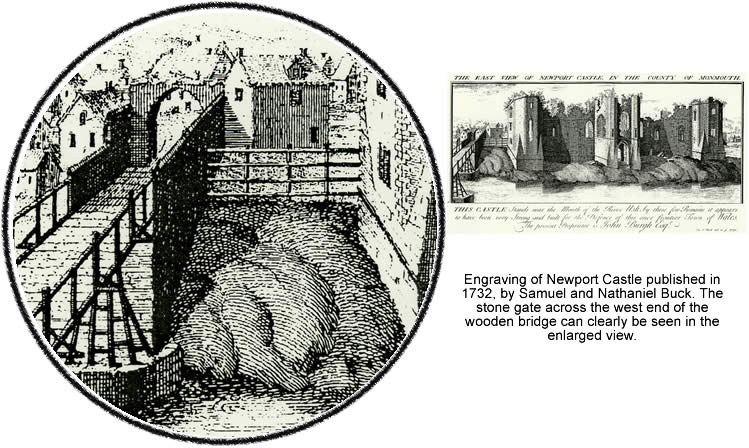
William Coxe recorded that:
The pivots belonging to the hinges of the east gate, near the bridge, are discernible in the walls. [4]
The West Gate is still commemorated by the Westgate Hotel building and it would have crossed the road between High Street and Stow Hill. Commercial Street was not constructed until the nineteenth century. A previous gate may have been nearer to Skinner Street, because a restriction in the width of High Street just at the junction with Skinner Street can be seen on early maps of the town. This first gate may be one mentioned in a deed of 1444 which refers to:
A tenement in the small bailey near the gate of the aforesaid town, where the hundred house was built above. [5]
The second gate, which contained a gaol, but presumably no longer the Hundred House, is probably fifteenth century and could have been built soon after 1476. A charter of that year gave the burgesses the right to build a gaol within the town. [6] This gate was demolished in 1799. It was replaced with a hotel, and this in turn was replaced by the present building in 1884. The proprietor of the Westgate Hotel at that time was Mr Samuel Dean. He recorded that:
In excavating underneath the old (former) Westgate Hotel, preparing the foundations of the present building, the workmen came across an old spiral stairway, and at the bottom a stone porch, forming the entrance into a subterraneous passage or subway, was discovered, leading under the road (Stow Hill). [7]
In the 1570 survey of rents in Newport owed to the Earl of Pembroke, there is a reference to ‘Crooks Gate’. [8] This appears to be the West Gate, and probably refers to the gaol in the gate. In 1801 William Coxe referred to the West Gate as having been used as the town prison, and that it had lately been taken down. He called it an ancient structure in the gothic style, built of red grit stone, with a shield charged with a chevron on each side. The shield was probably from the coat of arms of the earls of Stafford, later dukes of Buckingham, and lords of Newport from 1347 until 1521.
The location of the Middle Gate cannot be identified from Coxe’s account, and it has been suggested that it stood in the middle of the High Street. (4 on the conjectural view of Medieval Newport) The 1884 Ordnance Survey map identifies it as being close to the Murenger House. However a logical position would have been in Thomas Street. This street used to go from alongside the old Post Office building in High Street, opposite the Kings Head Hotel, providing access to the mill and to the north of the town.
In addition to these three gates there appear to have been other gates. Newport Castle had both a north and south gate in its curtain wall, and there are records of a Paynes Gate, which gave access to Baneswell and a gate between the Austin Friars and the town wharf. Of course these gates may not have been defensive structures, and James Matthews even refers to the old West Gate as a toll booth.
There is also the present public house called the Murenger House, at 53 High Street. It has been claimed by tradition that it belonged to the Murenger (an official responsible for town walls and for collecting money for their maintenance in the Middle Ages). In fact the Murenger House has a mainly modern timber framed frontage, with three upper stories under the gable. The first floor front room has a plasterwork ceiling decorated with a Tudor roses and floral pinecone finials. It appears to be Tudor, or, according to John Newman, early 17th century in date, [9] and therefore after any town wall would have been in use. However the thickness of the side and rear wall may indicate these were built of stone, and they could be considerably older than the frontage .The building is only referred to in local directories as ‘The Murenger House’ after 1880.
There are earlier references to another Murenger House, with a shield and arms carved over the front door. In 1801 William Coxe refers to the Murenger’s House as being ‘an old spacious building, with an ornamented front, and a coat of arms, carved in stone, over the door’, and it appears this building was demolished in 1816. It stood on the corner of High Street and the modern Bridge Street, on the site now occupied by the NatWest Bank. In 1750 it was referred to as ‘The Great House’ and in 1553 was the house of George ap Morgan and was described as ‘the strongest place in all the town’. [10]
There is at least some limited documentary evidence to suggest that Newport had town walls. A 12th century charter by William, earl of Gloucester, refers to granting the Priory of Goldcliff property ‘outside the walls in Newport’. [11] A deed dated 1433 exists in which Humphrey, earl of Stafford, granted John of Newport the right to erect and maintain a tenement ‘situated on the walls of the town adjacent to Gervey’s Gowte’. The origin of ‘Gervey’ is probably the personal name Gervais, but ‘Gowte’ means gate, often associated with sluice gates used in drainage. [12] This is little to go on, but there are many references to the Great Bailey and the Small Bailey of the town. The term ‘bailey’ usually refers to the area inside the circuit walls of a castle or town. In the case of Newport these baileys contain most of the town burgage plots, which in the 1570 survey were still paying rents to the lord.
As mentioned earlier the Great Bailey covered the area from the castle to the town pill, and included most of High Street. The Small Bailey included an area from the West Gate to the river downstream from the town pill, but excluding the site of the Austin Friars. The properties on Stow Hill and Mill Street would also have been outside the town baileys.
There is one clear record that shows that the Great Bailey had a wall. In 1444 John Seyntey sold various properties in Newport to Thomas Leny. These properties included:
A tenement ... in the great bailey in length along the highway at the front and up to the wall of the aforesaid bailey at the back ...
Seven unbuilt tenements, five of which lie together in the great bailey on the south side of the highway of the aforesaid town at the front, up to the wall of the aforesaid bailey at the back. [13]
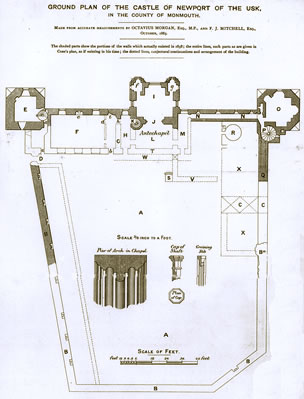
Newport Castle also had a curtain wall that once stood behind the surviving frontage. This was noted by William Coxe and a small part of the castle’s north curtain wall was standing until 1970 when it was removed during road widening. In 1885 the antiquarian Octavius Morgan produced a plan of the castle. The ward within the curtain wall was sub-rectangular. The south curtain wall was at a right angle to the main castle range alongside the river, but the north curtain wall was at an odd angle, slanting slightly to the south.